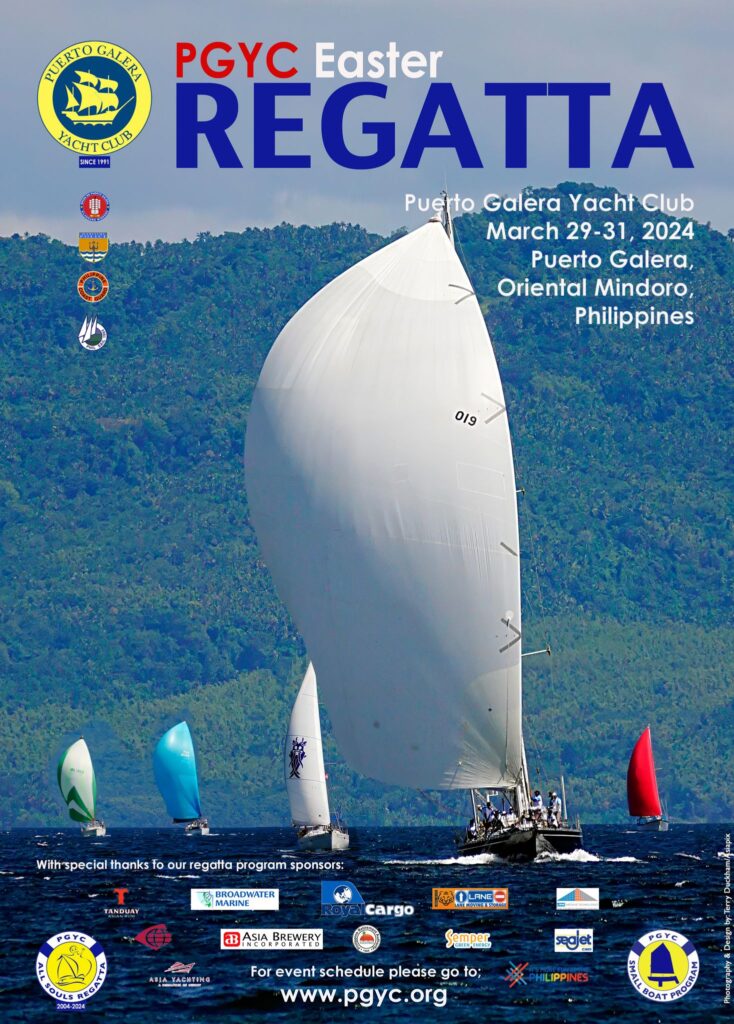
PGYC Easter
Regatta 2007
PGYC Easter
Regatta 2007
President’s Cup 2007, Boracay
©The Cruising Yacht Club
of the Philippines
June 2007
Manila
Boracay Race
2007
Manila
Boracay Race
2007
Commodore’s Letter
PGYC Board of Directors
Commodore: Peter Stevens
Vice Com: Mike Tucker, Jurgen Langemeier
Treasurer: Geoffrey Cannell
Directors: Michel Bigot, Carl Broqvist,
William Moore, Owen Stull,
Andrew Wrightson
-----------------
Secretary: Carlos Garcia
PGYC
Cruiser News,
June 2007
3
Philippine Copyright © 2003 - 07 by The
Puerto Galera Yacht Club, Inc.
All rights reserved.
Contents
Commodore’s Letter 3
Seen on our Moorings 5
Nature News: Snakes Alive Part II 6
The Mindoro Paraw 8
A Mermaid’s View of Sabang 10
Manila Boracay Race 2007 12
PGYC Easter Regatta 2007 18
President’s Cup 2007, Boracay 22
Vivace’s Paintjob and Maya Maya 25
Dream Boats - Christian’s Cat Part I 29
Yacht Friendly Moorings
- Coral Cove Puerto Galera 33
Production
Sales & Distribution: DeBe Enterprise &
Service (+63 917 846 3388)
Design: Terry Duckham/Asiapix Studios
Layout: Aira Fernando/Asiapix Studios
Front Cover : Johannes Zehethofer/Mark
Haswell
Special Thanks: Martyn Willes
Cruiser News is published by
Puerto Galera Yacht Club Inc.,
P.O.Box 30450 Sto Niño,
Puerto Galera, Mindoro, Philippines
Tel / Fax : 63 (043) 442-0136
Email: info@pgyc.org
www.pgyc.org
As summer approaches things are starting to wind down
here. By the time
this is published we’ll be into restricted opening hours
at the club to try to keep
overheads down over the low season. Rest assured that
it’ll still be all systems go at
the weekends and evenings so we look forward to seeing
you here.
The Easter Regatta was a great success with a dozen or so
yachts taking part.
This edition has a full report of the proceedings but I’d
just like to thanks all of you
who took part for making the effort and for making the
event so much fun. Special
thanks to Bill and Russ for organising the sailing side
and to our staff for keeping us
all fed and watered so well.
The event wouldn’t be the same without the support of the
guys from Future
Trade Int’l Inc for supplying the LINDEMANS wines and
trophies, and the Big
Apple team for the T-shirts. Finally thanks to Keith
Elliot of BINSWANGER for
the event sponsorship. I look forward to seeing you all
at the All Souls event in
November.
The acquisition of the parcel of land next to the club is
just about finalised.
As of today we are just waiting for the paperwork to be
completed. With luck, by
the time we move into the high season in October, you’ll
be able to drive or take a
tricycle directly to club from the main road. Thanks to
those members who helped
us with this important development project for the club.
On the food and beverage front we have received a serious
proposal from a
member to take over the operation on a concession basis.
We have been struggling
for years to maintain the efficiency and standards of
the bar and restaurant and
have been through a number of combinations of systems and
personalities. I can’t
go into too much detail at this time as there are still
many ‘t’s to be crossed and ‘i’s
to be dotted but we are all optimistic that what we have
in front of us is a serious
proposition with a real chance of success for all
concerned, particularly members and
visitors.
As this is the time of the year when many of our members
and friends head
off to wherever ‘home’ is or used to be, I’d like to wish
you all a safe journey and a
relaxing holiday. Haste ye back.
Best wishes and fair winds
Peter Stevens
15th June 2007
The views expressed in Cruiser News are those of the
authors and not PGYC. No responsibility for any loss is
accepted by the authors or by PGYC
PGYC
June 2007
5
We are ready. All our Muelle moorings have been
overhauled.
A new team of divers checked underwater all the non-
movable gear and working closely with our experienced
marine staff, unshackled the riding chains which were
brought
to the surface. After chipping and scrubbing, doubtful
bits of
chain, distorted shackles and worn swivels were replaced
and
all reassembled.
The weakest links, the vessels own mooring ropes
have been renewed to suit the skippers preferred
attachment
points on the vessel. Our club staff spliced the heavy
duty
Nylon rope, fit metal thimbles and chaff protection
hoses and
shackled them onto the buoy. This does not come cheap but
if
you use a swinging mooring it is one of the expenses you
must
budget for every few years.
So ‘Tin Hau’, Goddess of the Sea, please look kindly on
us in 2007. We have done our best to be prepared for your
worse
storms!
Recent visitors include:
Lindsay Walkley in 40 ft Australian registered ‘Avolare’
from Cebu.
Member Steindor Sigurgeirsson from Iceland in ‘Ying
Mei’ a 48 ft power yacht.
‘Drac III’ a James Wharram
catamaran registered in Tahiti with owner
Robert Fabre.
‘Amber Nectar’ 37 ft with owner
Karin de Vaal from Dili, East Timor on the
way to Kudat, Sabah.
‘Ilihune’ a 45 ft Van de Stadt,
registered in Japan with owner Don
Skurauskis from Coron to Boracay.
Old friends, Bill & Sylvia Goodwin,
in their Roberts 48 ft ‘Vivace’
‘Tai Mo Shan’ 46 ft with owner David
Smith from Hebe Haven Yacht Club.
36 ft ‘Petima’ with owner Peter
Moller from Palau to Hong Kong.
Previously visitor Thomas Hasse in 30
ft‘Wahoo’.
Alan Reid brought in Hong Kong
registered ‘King Kong’ a beautiful French
built 38 footer, for owner, new PGYC
member Thierry Magnan.
New Zealand registered ‘Alluna’ 46 ft, with owner
Andrew Kellow and skipper Kylie Ayson from Cebu to San
Fernando.
Polish registered ‘Panika’ a Bruce Roberts 38 ft, with
owner Andrzej Plewik and Krystyna Plewik.
Tayana 55, ‘Sirius’ with owner Andrew Jeffries from
Royal Hong Kong Yacht Club on the way to Subic.
‘Moonshadow’ a Tayana 58 with owner Richard
Beaumont.
‘Megumi’ 57 ft Azimut with owner Hiroyuki Tsuchiya.
‘Sik Fung’ a Tayana 38, with owner Alfons Grieb from
Hebe Haven Yacht Club on the way to Kota Kinabalu.
‘Mellow Yellow’ 39 ft with British owner John Duckett
from Subic Bay to Boracay.
USA registered ‘Cadence’ an Apache 40, with owner
Frank Ohlinger on the way to Coron.
Jean Rheault with ‘Sequoyah’ 41 ft from Guam to
Thailand.
Lucas Klarenbeek on his beautiful S&S 51 ‘Bluefin’
on
the way from Hong Kong to Kota Kinabalu.
And a warm welcome to member Gundolf Alrens who
has returned with ‘Aragon’ after a major refit
undertaken with
local craftsmen in nearby Minolo Bay.
Those cruisers, who might need a mooring in a beautiful
natural harbour, send us an e-mail, phone call or VHF
channel 68 on your approach. Puerto Galera has good
stores
(including real delicatessens), friendly bars and
restaurants and
our clubhouse can provide a broadband computer link,
faxes,
phones, showers and much more. And there are a variety of
local
tradesmen to assist with yacht maintenance.
By Mike Tucker Photo by Terry Duckham
Seen on our Moorings
The cruising yachts moving south have all left
on the last of the amihan’s north-east winds. The
habagat’s south-westerly winds started recently and
soon it will bring the daily rains and we should
expect the first season’s typhoons.
PGYC
June 2007
6
Words and Photos by:
Peter Stevens
NATURE NEWS
NAKES ALIVE!!
NATURE NEWS
At the main entrance I was just admiring Big Bertha, a
huge Burmese Python and his/her albino friend, Wilma,
when
I was met by Mike, a young American graduate in marine
biology who works there as a volunteer. An enthusiastic,
eloquent guide he presented a very well-informed and
interesting tour. On another day you might get Mario’s
son,
Benny, or their Filipino snake-man, Arnold.
Introductions over we started the tour with a few ‘do’s’
and ‘don’ts’, such as ‘don’t stick your fingers in the
cages’ (who on
earth would?), ‘don’t bang on the glass’ and‘take your
shoes off in
the snake house’ (can you run faster without flipflops?).
We started with my pals the pythons and I was not
surprised to find that Big Bertha is six years old,
6-metres long
and 90kgs! I had previously toyed with the idea of a
photo
opportunity with her draped playfully around my neck. I
decided on discretion rather than valour and we moved
onto
the crocs.
AfterCrocodylus mindorensis (remember him as the most
endangered species of croc in the World and that Mario
has
one of the few successful breeding programs?), we moved
onto the GHARIAL; a vicious looking tyke with a long thin
snout and wicked teeth. Thankfully it’s only a couple of
feet
long. From there we went over to the CAIMAN enclosure.
These are more similar to alligators than true crocs and
are to
be found in Central and South America. If watching a
leather
log lying in the sun doing nothing all day is your idea
of
adventure, then these are the guys for you.
From there (after a short stop to admire Ice Bear, the
only albino Malay Civet in captivity anywhere in the
World)
we moved onto something that promised to be MUCH more
exciting …. the SNAKE HOUSE!
At the entrance Mike introduced me to the many
varieties of pit viper to be found in the Philippines.
Previously
thought to be just one species, they have now found that
there
are many, all with slightly different colour of body,
stripes or
eyes, as well as size. So, if you happen to be bitten by
one in
the woods, take a few seconds to note whether the eyes
were
red, yellow or brown. Mario would be very interested.
Thanks!
Why PIT-VIPER? The name doesn’t refer to their
preferred habitat. They don’t live in big holes in the
ground
but up in the trees. It refers instead to two
indentations (pits)
on the front of the head, below the eyes. These are heat-
sensitive receptors which, amazingly, are wired directly
into
the snake’s optical system. In other words it ‘sees’ a
normal
image through its eyes, overlaid with a thermal image
from the
heat sensors. Cool stuff eh?
NAKES ALIVE!!
PART II
Ed: In the March edition of CRUISER NEWS Peter Stevens
promised to re-visit Mario for a tour of
the facility. Here’s what happened . . .
Mike and pits
PGYC
June 2007
7
Then it was shoes off and into an ophidiphobes’ worst
nightmare. (see – our quiz nights are paying dividends!).
Inside
were 144 glass display cases, which allowed up close and
personal, eyeball to scaly eyeball views of dozens of
species
of cobras, vipers, pythons, boas and one or two even more
dangerous critters. I personally found it fascinating and
was
thrilled to be able to marvel at the sheer beauty of the
colours,
shape, form and variety of the snakes at close quarters.
We started with Central and South American pit-vipers
(Mario has an exchange program with various zoos around
the
World to ensure successful breeding programs for
endangered
species) and then moved down the racks to the European
Long-nosed Viper and round the corner to the constrictors
(Did you know that the difference between boas and
pythons
is that the former are strictly New World and give birth
to live
young, while the latter live in our part of the World and
lay eggs?).
We interrupted an albino Burmese Python getting stuck
into a
dead (by then) chicken. Albinism in the wild is extremely
rare
(I mean – how can a white snake creep up on anything?!)
but
the pet trade has very successfully bred loads of albino
pythons
and they are a very popular pet – hence Mario’s guest
which
was surrendered or seized, I’m not sure which.
I remarked to Mike on the beautiful markings of the
Reticulated Python. The next thing I knew he opened the
case, picked up the snake and gave it to me. Now, I love
wild
things and snakes hold no fear for me, although I’ve not
had the chance to handle many before. But I must admit to
reluctance to drape a 6-foot animal that kills by
suffocating its
prey, round my neck! So it was arms only. Adult retics
are the
longest snake in the world and grow to 10m (33 feet) so I
was
glad that my friend was only a youngster. We both
survived
the encounter with, apparently, no ill effects and back
into the
case it went.
Pete
There will be more . . .
Left: Python snacking Above: Reticulated python
PGYC
September 2006
8
PGYC
June 2007
Words and Photos by Martyn Willes
The native paraw is an outrigger boat made from local
woods & bamboo and usually rigged with,
easily-deployed,
lanteen sails. Similar boats have been used in the
Philippines
for seven hundred years or more and, although the hull-
shape may vary slightly from locale to locale, the
function is
universal: to convey the fisherman to his fishing
grounds and
to safely deliver him home with his catch, with the
minimum
of effort.
In honour of our fellow sailors who have
mastered the baffling breezes around Dumlai
Point we offer this colourful review.
Although fishing boats of a design must
have been in existence around the Philippines
for millennia the first recorded (if we may be
allowed to elevate legend to record) “paraw” can be found
in
the, pre-Spanish era, Maragtas legend. The legend
concerns
ten Bornean chieftains (“datus”) fleeing the despotic
Sultan
Makatunaw. The datus, led by Datu Puti, reached Panay
Island (immediately South of Mindoro) in 1212 AD. It is
said
that the paraw seen today, with its colourful sails, is
the same
in design as used by the datus in their escape. The
legend goes
on to describe how the datus bartered with Haring (King)
Marikudo – the head of the indigenous ‘Ati’ peoples of
Panay
– for the island lowlands in exchange for a golden hat
and
necklace.
The paraws seen off the East coast of Mindoro during
the Manila to Boracay Race come from the municipalities
of Pola and Naujan near Dumali Point; they are still
almost
exclusively wind powered – in other areas, where fuel and
spare parts are more readily available, most fishermen
have
thrown away their sails in favour of
noise-and-air-polluting
internal combustion engines.
PGYC
June 2007
9
The most beautifully decorated lanteen sails are seen in
the vicinity of Pola; birth place of Philippine
Vice-President
Noli de Castro. They are made (and patched) from whatever
materials are readily available: tarpaulins, rice sacks,
discarded
clothes etc. and, as we discovered upon closer inspection
of
one boat, even the fabric from old umbrellas can be
fashioned
into a colouful and lightweight sail.
Sailor help Sailor: As encouragement to keep these
delightful fishing boats exclusively wind-powered we ask
the
skippers amongst our readership to donate an old
spinnaker or
two for use as paraw sail material. If you have an old
spinnaker
laying in your sail-locker just waiting for useful employ
then
please contact the Puerto Galera Yacht Club and we will
make
the necessary arrangements to have them delivered to the
fishermen’s cooperative . . . Alan Burrell has already
donated
Rags’s spinnaker (that she blew-out during the
President’s
Cup) and Ray Ordoveza has donated two from Karakoa. More
please.
bat fish, surgeon fish and rabbits in abundance but the
real
attraction of the Sabang Wrecks is the frog fish.
“It is a very popular night dive also.”
Mermaid Divers offer courses from discover scuba
through to dive instructor but
do not yet get involved with
technical diving, “we hope to
do that in the future . . . we
are working our way up the
ladder.
“We are probably ranked
at number six in Puerto Galera
at the moment but our goal
is to be in the top three very
soon.
“But for me” Rickie goes
on, “technical and commercial
diving is not half the fun
because deeper than 30
meters there is little light and
PGYC
June 2007
10
Rickie Cui is one of two dive instructors at
the Mermaid Divers’ dive shop on Sabang Beach,
just three minutes from the Batangas ferry landing
station; we spent a morning discovering what has
kept him so enthralled with the Sabang Wrecks dive
site for so many years.
“It’s a great site for divers of any level of
experience . . . the fun actually starts before the
Sabang Wreck because the Sabang Reef, just beyond
the floating bar, is like the 12-metre hors d’oeuvre
for the 18-metre main course” enthuses Rickie,
“There you can find a myriad of reef fish and corals
sporting all the colours of the rainbow . . . it is a
fantastic place
for the macro (close-up) photographer”.
The Mermaid Divers have cameras for rent but if they
are all out, and you are just itching to buy one anyway,
there is
a camera shop in the street behind.
“At the wreck site there are three wrecks laying on a
sandy bottom where you can see rays and scorpion fish
and
if you have one of our
experienced diver masters
as guides they will help
you spot the perfectly
camouflaged star gazers”
Rickie goes on, “two of the
wrecks are wooden and one
is steel . . . all have been
sunk deliberately over the
past twenty five years to
create this amazing dive site.
“Although the wooden
boats are mostly rotten now
the steel yacht is solid and
can be penetrated . . . there
are moray eels in residence,
Words by John Smart
Photos by Rickie Cui & Martyn Willes
Sabang is famous for its many on-beach
attractions that deliver a feast of creature comforts
throughout the day and long into the night,
but take a peek beneath its shimmering
waters and a whole new world of creatures
come into view, who have been feasting on
each other almost since time began.
Above: Divers investigate Sabang Wreck frog fish
Below: Hawksbill Turtle poses for the camera
PGYC
June 2007
11
everything is the same colour”.
The dive shop has basic rooms for
rent, all with air-conditioning, double beds
and hot & cold running water; starting
at Php1,200. Because it is attached to
the larger Mermaid Resort (also
in Sabang) it can offer guests
everything up to a fully appointed
penthouse suite, with private
balcony and Jacuzzi, for around
Php4,500 a night.
While chatting to Rickie and
the other dive instructor Chris, a
young married couple from Manila
arrived back off the dive boat
bubbling with excitement, having
done “the wrecks”. After earlier
listening to Rickie’s enthusiasm I
thought I would just test his words; I asked them to
describe
the highlights in a couple of words: “Frog fish” said
Ian
Sayson, more usually fishing information for Bloomberg
in
Makati City; “Sabang is the
best” confirmed Dra. Jennifer
Manzano. I asked Jennifer to
elaborate. “Value for money .
. . from the rooms here to the
unlimited diving packages.
“Sabang is the best place
. . . it is too chaotic on White
Beach.
“We have dived many
places in the Philippines
including Palawan but Puerto Galera
stands out on its own”.
As Jennifer and Ian prepared
for their next dive, “we hope to do
four today” Jennifer asserted, I could
not resist asking Rickie if there were
any mermaids to be found in the bay.
“Turtles sometimes . . . never seen a
mermaid . . . but at night after a party
maybe . . .” he laughed.
For more information contact Mermaid Resort: tel. +63
43 287-3301; info@mermaidresort.com
Right:All materials available for PADI courses
Bottom: Equipment available for hire so you can
travel light
PGYC
June 2007
12
We were approaching five hours, 26 miles, into the
204-mile, 2007 Manila to Boracay Race; the going had been
slower than anticipated in the light, shifty, mostly
northerly
winds since the start. And now it was a whole new race
for the
bulk of the fleet.
Getting there: it was an uncharacteristic beat for the
14 miles out to the Saint Nicholas Shoal light – at this
time
of year we could have expected a following breeze and a
fast
spinnaker run – with just a handful of boats to our rear.
Ahead of us Frank Pong’s enormous, 115-foot Maiden Hong
Kong was already disappearing South around Limbones Point
and on along the Batangas coast. The other “big boats” in
the racing division – Karakoa, Mandrake, Centennial,
Ffreefire
and Hummingbird -- were almost at the horizon, sailing
high towards Corregidor Island. These were followed by
the
other boats in the IRC Racer and PY Cruiser divisions.
Some
had seen enough of a shift in the breeze to hoist rather
shy
spinnakers. The sun was dipping towards the South China
Sea
and the sky was slowly turning a brilliant orange.
We had raised our own spinnaker and, although it was
also very shy, we could sense the breeze was slowly
veering;
there was a slightly agitated wind line off our stern and
we
licked our lips in anticipation of catching up to a few
of our
quicker rivals immediately ahead.
Discussions ensued using the rationale that a more
easterly breeze would turn somewhat southerly as it was
forced
around the steep hills on the Batangas side of Manila
Bay.
The fundamental question being ruminated was: should we
gybe to the South when the rest of the fleet was sailing
West
out of the bay into the gathering twilight. The argument
was
that if the breeze softened again then we would be left
in the
lee of the hills and struggle to maintain headway against
the
still flooding tide; if the breeze maintained or
increased we
would be sitting rather pretty. Mark Haswell and I both
agreed
that the gybe was the best choice and, after five minutes
of
sustained veering of the breeze, the skipper was also
convinced.
The moment: “I count sixteen masts behind us” I called
out as our yacht
– Rags (Farr 1104) -- slid out of Manila Bay abeam
Carabao Island, “what a great
photograph . . . pity it’s dark”.
MANILA BORACAY RACE 2007
Words and Photos by Martyn Willes
PGYC
June2007
13
The breeze continued to fill in, as hoped; it bounced
off the hills, as predicted; we were foaming across flat
water
towards Fort Drum and momentarily overhauling everyone.
Two of the handful behind followed and enjoyed the same
benefit while the remainder followed the pack towards
Corregidor.
Seeing that our foaming wake and full spinnaker was
not an aberration the pack eventually cut their losses
and
turned South to join us; by the time darkness had
completely
enveloped us, abeam of Carabao Island, all but the
fastest of
the fast were behind us in a mass of billowing
spinnakers.
Magic! We had just gained a full hour and a half on
everyone
and were now unquestionably in first position in the IRC
division. Only 176 miles to go!
Onward: down the Batangas coast we saw some boats
obtain momentary advantage followed by disadvantage,
close
to the coast; others lost a little and then gained a
little, further
out to sea. The next thirty miles were uneventful except
that
eventually the wind veered past the point where we could
hold
the spinnaker and so the three-year-old whites came out.
Negotiating Cape Santiago, with wind up to 34 knots-
true, we beat up the Verde Passage towards the Puerto
Galera
peninsula with the masthead lights of Sandoway, Vivaldi
and
Salina for close company.
Uncharacteristically, we thought, Vivaldi did not take
the knock across to the Mindoro coast but instead opted
to
tack back North towards Balayan Bay; we watched her
slowly
disappear to our left. We would not see her again until
after
passing the Baco Islands . . .
Salina too did not take the knock all the way to the
coast but chose instead to tack up the center of the
Passage;
Sandoway did something similar and we lost sight of both
until sun-up.
We beat toward Mindoro until we could almost touch
the beach just West of Talipanan. Our first tack brought
us
clear of the next headland but the breeze shifted; it
came
cascading down the steep and ancient volcanic hills and
The winner of the IRC Cruiser Racer division and the
overall Kellet Island Trophy for the Manila Boracay Race
2007 was Harry Taylor’s, S & S 36, Irresistible. But
perhaps
we should have expected it seeing as the boat and the
sails
were all made in the Philippines.
The (Sparkman & Stephens) S & S 36 was one of ten
built in Mariveles, Bataan, during the 1980’s, when
sailing
was a burgeoning sport in Manila Bay and beyond. Viking
Express (Manila Boracay Race winner 2004) was the “plug”
for the mould that was used to make the others; some are
still around (Merkano and Nanu-Nanu are moored at the
Manila Yacht Club), while others have gone further afield
to
Hong Kong, Singapore and the U.S.A.
Irresistible’s sails were made in the Philippines by Hyde
Sails Cebu, a subsidiary of the UK sail manufacturer Hyde
Sails.
And, as Harry pointed out later, all of the crew have
made the Philippines their home for more than 25 years.
AND THE WINNER IS . . .
Continued on page 15
Top: Irresistible crew being congratulated by Jun
Avecilla, Co-chair MBR
Previous page: Irresistible crew cleans up: sails
billowed out across the passage, and lifted us all the
way to
Medio Island, Puerto Galera. The morning sun warmed
those sat on the rail and brought a most glorious sight
-- we
could see yacht-less horizon ahead and only
supposedly-faster
competitors behind.
A tack in towards Sabang Beach and another out again
we were past Puerto Galera and heading straight for the
Baco
Islands, some fifteen miles distant. We went out around
the
Baco Islands, taking advantage of the last of the flood
tide to
clear them at speed. We had stolen another hour or two on
the
fleet. Magic again! Only 100 miles to go.
Now Dumali Point, thirty miles down the coast, offered
the only threat to our position: if the breeze dropped
for us
but not for those behind us then they could all catch up
. . .
After our two successful decisions – to gybe out of
Manila Bay and taking the Verde Passage knock all the way
to
the coast of Mindoro – that had netted us three or more
hours
of cushion over our competitors we were feeling somewhat
invulnerable. The last major decision was how to tackle
Dumali Point.
In our four years of experience of this race there has
always been a lull in the breeze at Dumali Point; the
only
question is for how long the lull would last – an hour or
two
or from dawn ‘till dusk, ‘till dawn. Our predicament was
that
the breeze was steadily abating and
the sea surface becoming glassy.
Mark was convinced that the
noticeable swell from the northeast
was portend of a new breeze -- more
representative of the gradient wind
indicated by the various weather
services we had reviewed prior
to the race; I suggested that in
the absence of the northeasterly
promptly showing its face we should
tack in to the coast and benefit from
the very evident local, on-shore
breeze that was already creating a
neat line of little cumulous clouds
above the coastal plain.
The skipper stays with the
impending northeasterly theory;
out around the Baco Islands slips
PGYC
June2007
15
Manila Boracay Race... continued from page 13
Above: Klaas Huisjes drives Sandoway with her Hyde Sails
windward
wardrobe
Right:Awards night at the golf club
PGYC
June 2007
17
Sandoway, Challenge, Vivaldi, Selma Star and Salina.
The sun rises to its zenith as we drift along at an
average
of a knot; led by Sandoway one by one the other boats
tack
towards to the coast, eventually leaving us with only
Salina for
The first boat to reach Boracay was, not surprisingly,
Frank Pong’s majestic (if somewhat
aircraft-carrier-like),
115-foot, UK Sails powered, Maiden Hong Kong. However,
due to a miscalculation by the race organisers Frank was
forced to forego crossing the official finish line
because the
water beyond it shallowed much too quickly for the safe
passage of Maiden’s keel. “You can’t just stop this one
on a
dime” one crewman stated.
After some brief discussion by radio Maiden Hong
Kong (Juan 115 Custom) was allowed to “finish” by
crossing a transit from the committee boat to the leeward
rounding mark; interestingly she was still given a DNF
(“Did Not Finish”) on the score sheet.
For two reasons Frank did not really mind the DNF:
reliable sources suggest this race marked the first time
thatMaiden Hong Kong had run an incident free race
since her launch just over two years ago (now Frank can
set his sights on those other ocean racing records around
the world, with confidence in the design and durability
of
the components); and, he won overall in the IRC Racing
division of the President’s Cup Regatta, in the same
week,
aboard his 75-footer Jelik.
BUT LEST WE FORGET . . .
company; at some moments we are actually moving away from
the objective on the tide.
The sun: unrelenting. By mid afternoon we observe
smaller sails coming through the Baco Islands and hugging
the Mindoro coast, with speed. A realisation overtakes us
then: that even the smaller, slower boats have stolen a
march
on us and even if we tacked into the coast now they would
still probably beat us. “We still have a chance” I offer,
but
only if we act now: the majority still hopes for the
elusive
northeasterly.
When the GPS tells us that it will take 56 hours to
reach Dumali Point, still thirteen miles distant, the
skipper
orders the engine on and a radio message sent to the Race
Committee.
We motor along the coast past a line of yachts, now
drifting or standing upright, waiting for respite from
the lull
that has engulfed all. At Dumali Point the water is
almost
flat, with only the local fishermen in their painted-sail
paraws
making discernable headway towards any objective. In the
half-light of dusk we find Sandoway, out ahead of the
pack
and already around the Point, but with barely enough
breeze
to fill her spinnaker. What if we had tacked in ahead of
her
after rounding the Baco Islands? What if the northeast
had
filled in as it surely would do, eventually?
Two good decisions out of three aren’t bad but the one
we absolutely needed to get right evaded us. There is
always
next year . . .
Manila Boracay Race... continued from page 15
Most of us only saw her petticoat tails
Mark Haswell helms into a softening breeze after Baco
Rail Zen – Japanese charter enjoying the view
On day one we saw 24-knots true on the beat out to
Verde Island, where the mark boat yet again became the
mark as the buoy’s anchor line mysteriously parted about
one
hundred feet down.
On and downwind towards Chicken Feather Island
the breeze eased down to around 15 knots encouraging the
courageous to offer clean sterns and billowing spinnakers
to
the camerawo/men buffeted and bruised in the mark boat;
the breeze veered a little as competitors approached the
island
and the ebb tide drove them South of the rhumb line. Most
overlooked the tide and were forced to make a gybe to
round
the island but Sandoway saw an advantage in holding her
kite almost by-the-lee and in doing so stole a march of
five
minutes or more on the entire fleet.
Sling-shooting around Bonito Island and streaking
South across the Verde Island Passage once more, the
breeze
picked up to 18-knots to bring all but the few across the
finish
line with smiles to acknowledge a great race endowed with
the
blessings of the wind Gods.
Well the guys out there in Valencia, Spain,
may have had trouble finding the breeze but
here in paradise, in the most beautiful bay in
the world, the breeze just kept on coming.
P
G
Y
C
E
a
ste
r
R
e
g
atta
2
0
0
7
PGYC
June 2007
18
Day two and the Lindemans Cup saw the fleet taking
the shorter course around Bonito and Chicken Feather, in
the
clockwise for a change. Favouring the multi-hulls and the
old
ladies, this course proved that handicappers can get even
the
simplest of calculations wrong and no matter what the
young
bucks in their sporty racers tried to do they just could
not catch
Words by John Smart
Photos by Terry Duckham, Bernadette and
Martyn Willes
Rags rockets round Chicken Feather
Photo: Bernadette Willes
Freewheeler II short handed but long legged
Photo: Bernadette Willes
the old ladies in their majestic finery. Fitting then
that the prizes
for this Lindemans Cup race included some classic wines.
Again the wind Gods had offered up armfuls of power
and fistfuls of spray, delivering 14 to 18-knots of
Baco-Island-
bubbled-Verde-Island-funneled-breeze from out of the East.
The third day was a relief for some, as the breeze had